The drive back from Killeen gave me too much time to think, and that was a dangerous thing these days. When you're busy, you focus on the next task. The next meal. The next problem. But once you're alone with your thoughts and a couple hundred miles of Texas blacktop rolling beneath your tires, your mind starts wandering into places you'd rather avoid.
Fort Hood was one of those places.
I'd spent enough years in the Army to recognize a losing battle when I saw one, and what was happening behind those fences looked an awful lot like one. The soldiers were still fighting. They were still organized. They still had armored vehicles, helicopters, radios, chain of command, and enough ammunition to start a small war. But every time I looked at those walls, I kept coming back to the same thought.
They weren't winning.
They were surviving.
There is a difference.
Winning means conditions improve.
Surviving means you're just dying slower.
The farther I got from Killeen, the more convinced I became that the Army wasn't going to save anybody. Maybe they could hold the base another week. Maybe another month. Hell, maybe another year. But none of that mattered to people living out beyond the cities.
Out where I lived, the world had already changed.
The roads belonged to the infected.
The towns belonged to fear.
And the countryside belonged to whoever could defend it.
That realization followed me all the way back toward Miller Creek.
Duke spent most of the drive asleep with his head against the passenger door. Every now and then he'd lift his muzzle, sniff the air coming through the cracked window, then settle back down again. I wish life were that simple for people.
A dog sees the world exactly as it is.
Food.
Water.
Shelter.
Friendship.
Everything else is noise.
Humans complicate things.
The evidence sat beside the highway every few miles.
Burned-out vehicles.
Abandoned trucks.
Overturned trailers.
A motorhome sitting crooked in a ditch with every cabinet hanging open and half its contents scattered across the grass.
Somewhere along the way I realized I hadn't seen another moving vehicle in nearly forty minutes.
That would've been impossible a month ago.
Now it barely registered.
The apocalypse has a funny way of recalibrating your expectations.
A traffic jam used to ruin your day.
Now an empty highway felt normal.
By the time I reached Miller Creek, darkness had settled across the county. The last traces of sunlight were fading behind the cedar-covered hills to the west, leaving everything painted in shades of blue and black.
Normally I'd pull beside the house.
That night I didn't.
Instead, I drove behind the barn and parked where the truck couldn't easily be seen from the road.
Maybe it was paranoia.
Maybe it was instinct.
Either way, I listened.
The engine ticked softly as it cooled.
Crickets chirped in the grass.
Somewhere off in the distance, a coyote barked.
Nothing sounded unusual.
Still, I sat there another minute before opening the door.
Something had been bothering me since Killeen.
Actually, if I was being honest, it had been bothering me for several days.
The tracks near the smokehouse.
The movement I'd spotted near my deer stand.
The uneasy feeling that somebody had been watching from the tree line when I couldn't quite prove it.
Individually, none of those things meant much.
Together, they started forming a picture.
And I didn't like the picture.
Duke jumped out and stretched before looking back at me.
"You got a better feeling about this than I do?" I asked.
His tail thumped once.
Not exactly helpful.
Then again, he probably would've followed me straight into hell if I asked nicely.
The old dog and I made a slow circuit around the property before heading inside. I checked the barn, the smokehouse, the fence line nearest the creek, and the small trail leading toward the woods behind the house.
Nothing looked disturbed.
No fresh tracks.
No broken branches.
No signs of trouble.
I should've felt relieved.
Instead, the feeling got worse.
That happens sometimes.
People think danger announces itself with noise.
With shouting.
With gunfire.
The truth is that real danger is often quiet.
You don't hear it.
You feel it.
That night I slept lightly.
The Ravin rested beside the bed.
My pistol sat within arm's reach.
An EcoGear FX flashlight lay on the nightstand.
Every few hours I woke up, listened to the darkness, and went back to sleep.
Sometime before dawn, Duke growled.
The sound wasn't loud.
It didn't need to be.
His growl carried a warning I'd learned to trust.
I was out of bed before my eyes were fully open.
The room was still dark when I grabbed the flashlight and moved toward the window. Outside, the first hints of daylight were beginning to creep across the pasture.
At first I didn't see anything.
Then Duke headed for the back door.
Purposefully.
Silently.
The way he did whenever he'd picked up a scent worth investigating.
I followed him outside.
The morning air felt cool against my face. Dew coated the grass. A thin layer of mist hovered over Miller Creek, drifting slowly between the trees.
Duke led me toward the crossing behind the house.
Halfway there, he stopped.
I looked down.
Tracks.
Fresh ones.
Three separate sets of boot prints cut through the damp earth and headed straight across my property.
I crouched beside the nearest impression and felt my stomach tighten.
The edges were still sharp.
The dew hadn't settled inside them yet.
Whoever made them couldn't have been more than a few hours ahead of us.
I followed the trail with my eyes.
It led directly toward the smokehouse.
And right then, before I even stood up, I knew exactly what I was going to find.
The tracks led exactly where I expected them to.
That didn't make it any easier.
I followed them across the pasture, moving slowly now, taking my time to study every sign they left behind. Three men. Heavy boots. No effort to conceal their movement. Whoever they were, they weren't worried about being tracked. Either they were stupid, confident, or both.
None of those possibilities made me feel better.
The smokehouse sat beneath a cluster of live oaks about fifty yards behind the barn. I'd built it myself years ago, back when weekends were spent thinking about deer season instead of survival. For a long time it had been little more than a hobby. Now it represented something far more important.
Food.
Security.
Time.
When the world ended, calories became currency.
I knew that better than most.
The door stood partially open when I reached it.
I stopped a few feet away and stared at it for a moment. The sight irritated me far more than it should have. It wasn't just that someone had entered my property. It was the casual way they'd done it. Like they weren't concerned about getting caught. Like they didn't care if I knew.
That was the part that bothered me.
Not the theft.
The disrespect.
I stepped inside.
The smell of smoked venison still hung in the air. Normally it was a comforting scent. That morning, it felt like an insult.
Several strips were gone.
Not all of them.
Just enough.
I stood there counting empty spaces where meat had been hanging the day before.
Maybe ten pounds.
Maybe fifteen.
Enough to matter.
Not enough to cripple me.
The more I looked at it, the more deliberate it felt.
A professional thief would've cleaned the place out.
A desperate survivor would've grabbed everything he could carry.
This felt different.
This felt like a warning.
Or a test.
I walked back outside and looked toward the woods.
The tree line stared back silently.
Somewhere out there were three men who knew where I lived.
Three men who knew where I stored food.
Three men who'd decided they could take what they wanted.
That changed the equation.
The infected were dangerous because they were relentless.
People were dangerous because they were creative.
A fever walker only had one plan.
Humans had options.
Duke sniffed around the smokehouse while I studied the ground. The tracks were easy enough to follow. They'd approached from the north side of the property, crossed the pasture, visited the smokehouse, then headed back the same direction.
The route told me something.
They weren't wandering.
They knew exactly where they were going.
That realization sat heavy in my chest as I followed the trail a few hundred yards into the woods. The signs became harder to spot beneath the cedars, but they were still there if you knew what to look for. Scuffed soil. Broken twigs. Disturbed leaves.
Three men moving together leave a surprising amount of evidence.
By the time I returned to the house, I'd reached a conclusion I didn't like.
I wasn't hidden anymore.
For nearly a month, Miller Creek had felt isolated from the worst of the collapse. The infected wandered through occasionally, but I'd learned how to deal with them. Distance had become my greatest ally. Most survivors stayed near towns and highways where supplies were easier to find.
Apparently these men were different.
They were hunting.
Maybe not deer.
Maybe not even food.
But they were hunting something.
And somehow their trail had crossed mine.
The rest of the morning disappeared into preparation. I checked every weapon, inventoried every remaining food supply, and walked the perimeter twice more. The process calmed me. Years in the Army had taught me that action beats worry every single time. Sitting around imagining problems doesn't accomplish much.
Preparation does.
By noon, I'd reached another decision.
If somebody was watching me, I needed to know who they were.
The only way to do that was to find them.
I packed lightly. The Ravin went over my shoulder. A canteen rode on my belt. My binoculars slipped into a small pack alongside a few essentials. Duke watched the entire process from the porch.
"You coming?" I asked.
His tail thumped immediately.
I figured that meant yes.
We headed north.
The trail picked up almost immediately beyond the property line. Fresh signs appeared every few hundred yards, confirming what I'd already suspected.
These men weren't nearly as disciplined as they thought.
The farther we traveled, the more evidence they left behind. One man had a habit of dragging his right foot slightly when walking downhill. Another favored a heavier stride that left deeper impressions in soft ground. Tiny details most people would've missed.
I noticed them.
Tracking isn't magic.
It's observation.
Most people simply don't pay attention.
The afternoon sun hung high overhead by the time Duke and I reached a rocky ridgeline overlooking an abandoned ranch. The moment I spotted smoke drifting through the trees, I knew we'd found them.
I dropped to one knee and raised the binoculars.
The ranch house looked half-dead. Weathered boards covered the exterior. Several windows were broken. Part of the roof had collapsed near one corner.
The men living there didn't seem concerned.
Three figures moved around the property.
One sat on the porch cleaning a rifle.
Another tended a fire pit.
The third wore an old deputy's jacket and spent most of his time pacing while the others worked.
Interesting.
Very interesting.
I settled beneath a cedar tree and watched.
Minutes turned into hours.
The longer I observed, the more I learned.
The deputy jacket was clearly the leader.
The rifleman handled security.
The third man followed orders.
Simple.
Predictable.
And predictability creates opportunities.
At one point the deputy disappeared inside the house while the rifleman walked to the creek carrying empty water jugs. He made the trip alone, without backup, without caution, and without once checking his surroundings.
That told me everything I needed to know.
These weren't professionals.
They were opportunists.
Dangerous opportunists.
The worst kind.
Because men like that eventually start believing they're smarter than everyone else.
I lowered the binoculars and glanced at Duke.
The old dog lay quietly beside me, watching the ranch house with the same calm patience he'd shown during countless hunting trips.
For the first time all day, I felt something close to relief.
Not because the threat was gone.
Because it finally had a face.
I knew where they slept.
I knew how many there were.
And most importantly, I knew they were flesh and blood.
Predators.
Not ghosts.
That knowledge made the walk back to Miller Creek a lot easier.
Unfortunately, I was about to learn something else.
The hunt was only beginning.
For the next couple of days, I settled into a routine that probably would've looked normal to anybody watching from a distance. I checked traps, hauled water, worked around the property, and spent a little time every afternoon watching the ranch house from my ridge north of the creek. On the surface, nothing had changed.
Underneath, everything had.
Once you know someone is hunting you, every decision starts feeling different. Every trip away from camp becomes a calculated risk. Every noise in the woods gets your attention. Every shadow deserves a second look.
You stop relaxing.
You stop assuming.
You start thinking about angles, distances, and escape routes.
At least I did.
The strange thing was that the more time I spent observing the scavengers, the less impressed I became. The first time I'd spotted them, I'd imagined a disciplined group working together. The kind of men who'd survived because they were smarter than everybody else.
The truth turned out to be a lot less flattering.
They were sloppy.
They left trash around camp.
They argued constantly.
Half the time one of them wandered off by himself.
The deputy jacket spent most of his day acting important while the other two handled the actual work.
More than once I caught myself wondering how they were still alive.
Then I remembered something I'd seen throughout my military career.
Being dangerous and being competent aren't always the same thing.
A drunk with a rifle can still kill you.
An idiot can still pull a trigger.
The fact that these men were careless didn't make them harmless.
If anything, it made them more unpredictable.
That realization was still bouncing around in my head on the morning I discovered they'd come back.
The feeling hit me before I reached the smokehouse.
Maybe it was instinct.
Maybe it was experience.
Whatever it was, I knew something was wrong the second I saw the door.
It wasn't standing open this time.
It was hanging crooked.
Just enough to tell me someone had been there.
I broke into a jog.
By the time I reached the building, I was already angry.
Inside, the damage wasn't immediately obvious. The racks were still there. The tools were untouched. Nothing appeared broken.
Then I looked closer.
My stomach sank.
Half the remaining venison was gone.
Not a few strips.
Not enough for a meal.
Half.
I stood there staring at the empty space for a long moment, trying to convince myself I was overreacting. After all, it was only food. Deer still existed. Hunting was still possible.
But the more I thought about it, the angrier I became.
Food wasn't just food anymore.
Food was security.
Food was time.
Food was one less trip into the woods.
One less risk.
One less opportunity for something to go wrong.
Every pound they stole represented work I'd have to do again.
Hours I'd have to spend exposed.
Ammunition I'd have to burn.
Energy I'd have to waste.
Those bastards hadn't just taken venison.
They'd stolen future days of my life.
Duke sat quietly beside me while I worked through the anger.
The old dog understood enough to know when I was upset, but he was smart enough not to get in the way of it.
I finally let out a slow breath and forced myself to think.
Anger has its uses, It sharpens focus and motivates action.
But if you let it take control, it makes you stupid.
And stupid people don't survive long.
The scavengers had just proven something important.
They weren't afraid of me.
In fact, they were becoming more comfortable every time they visited.
The first theft had been cautious.
This one wasn't.
The next step wouldn't be stealing food.
The next step would be taking everything.
I spent the rest of the day moving supplies.
Every remaining piece of venison got relocated.
I buried part of it beneath a false floor in the barn. Another portion went into a sealed container hidden near the creek. The rest disappeared into a cedar thicket where nobody would find it unless they knew exactly where to look.
By the time I finished, darkness had settled over Miller Creek.
I sat on the porch that night cleaning the Ravin while Duke slept nearby.
The old crossbow had become one of the most valuable things I owned. It was reliable, accurate, and most importantly, quiet. Every firearm on the property had a place. Every tool served a purpose.
But the Ravin felt different.
A rifle solved problems.
A crossbow solved them discreetly.
The distinction mattered.
The moon climbed higher as the night wore on. Somewhere beyond the tree line, an owl called from the darkness. The sound reminded me of hunting trips years earlier, back when the biggest thing I worried about was whether deer season would be productive.
Funny how quickly priorities change.
Eventually I went inside and tried to sleep.
Tried being the important word.
My mind kept returning to the same thought.
The scavengers were escalating.
The question wasn't whether they'd come back.
The question was what they'd try next.
I got my answer two days later.
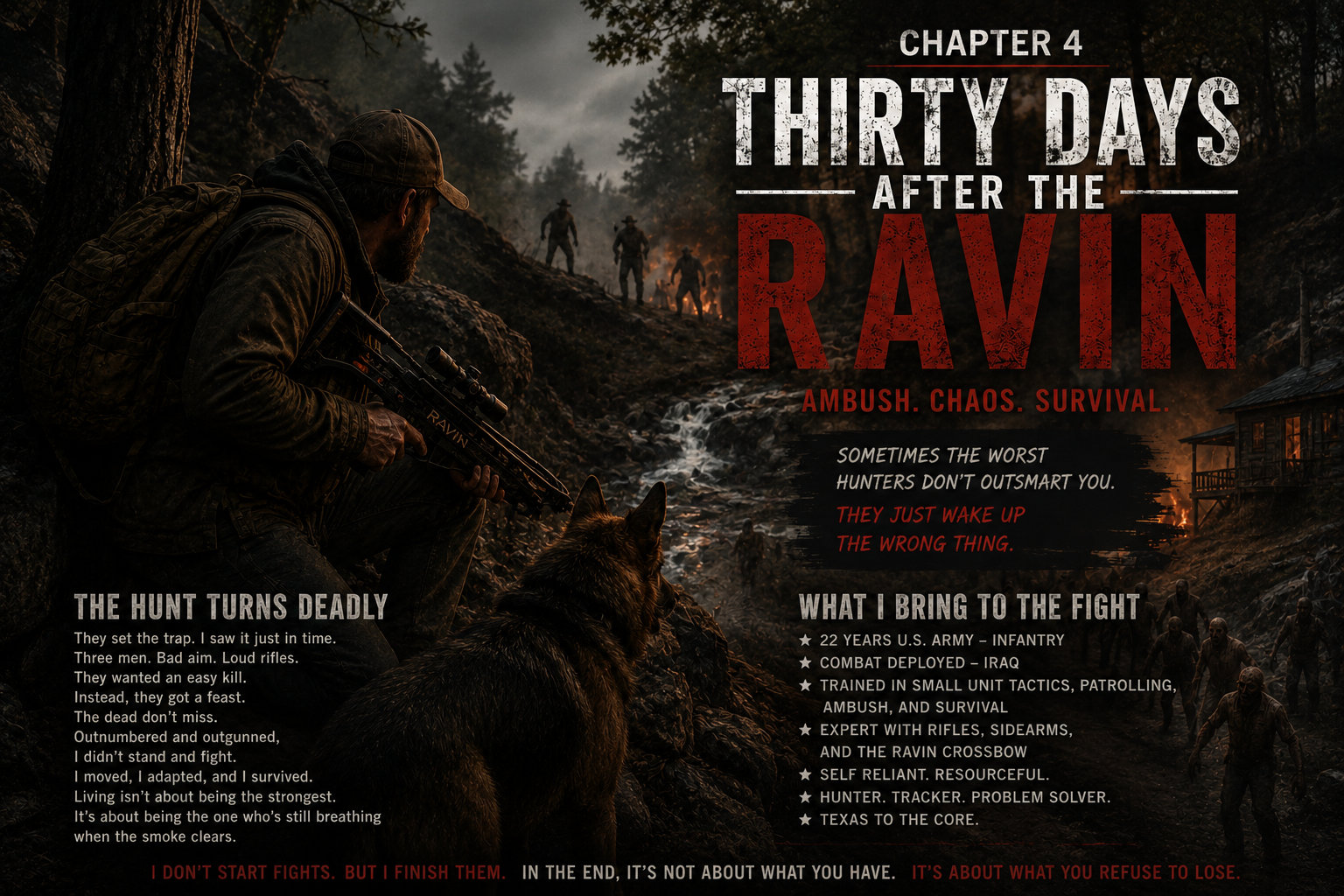
The morning had started normally enough. Duke and I were checking rabbit snares south of the creek, moving through a stretch of rocky terrain I'd hunted dozens of times over the years. The area was cut by narrow ravines and cedar-covered ridges that provided excellent cover for wildlife.
Unfortunately, they provided excellent cover for people too.
I was halfway down one of the draws when Duke stopped.
Not slowed.
Stopped.
The reaction was so sudden I nearly walked into him.
Every muscle in his body tightened.
His ears pointed forward.
His gaze locked onto something ahead.
Immediately, every alarm bell inside me started ringing.
Years of hunting together had taught me to trust that look.
Duke wasn't curious.
He wasn't distracted.
He'd found something.
Slowly, I lowered myself into a crouch and followed his line of sight.
At first, I saw nothing.
Just brush.
Cedars.
Shadows.
Then sunlight flashed briefly against metal.
A tiny reflection.
Gone almost instantly.
But it was enough.
A rifle barrel.
My pulse kicked up immediately.
Not from panic.
Recognition.
The scavengers weren't following me anymore.
They were waiting for me.
And suddenly the entire shape of the terrain changed in my mind.
The ravine narrowed ahead before opening into thicker timber. The ridges on either side overlooked the approach. Dense brush limited visibility.
It was a textbook ambush site.
The kind soldiers spend years learning to identify.
And I'd walked right into it.
Almost.
Very almost.
Slowly, carefully, I began backing away.
One step at a time.
No sudden movements.
No panic.
Just distance.
If I could create enough space, I might slip away without them ever realizing I'd seen them.
For a moment, I thought it might work.
Then my boot found a dry branch.
The crack echoed through the ravine like a gunshot.
Everything stopped.
The woods.
The voices.
The birds.
Even the wind seemed to pause.
Then somebody yelled.
"He's here!"
And the ambush exploded.
The moment that branch snapped, I knew the situation had gone bad.
Not maybe.
Not potentially.
Bad.
The kind of bad where people end up dead if they hesitate.
The shout came from somewhere ahead and slightly above me.
"He's here!"
A second later another voice joined it.
"There!"
Then the woods erupted.
Brush crashed.
Boots pounded against rock.
Branches snapped as the scavengers abandoned whatever patience they'd started with and came charging into the ravine.
I turned and moved immediately.
Not blindly.
Not recklessly.
Fast.
There is a difference.
Panic makes people run away from danger.
Training teaches you how to run toward survival.
The terrain I'd almost wandered into now became my lifeline. Every hunting trip, every season spent moving through those woods, every afternoon tracking deer along Miller Creek suddenly paid dividends. I knew where the ravine forked. I knew which route dead-ended against a limestone wall and which one opened into thicker cedar cover.
The scavengers didn't.
That mattered.
A lot.
Duke stayed right beside me as we moved through the brush. The old Lab might have been getting gray around the muzzle, but fear had a way of knocking years off a dog. He slipped through the cedars like he'd done it his entire life.
Behind us, the shouting grew louder.
I risked a glance over my shoulder.
Three men.
The deputy jacket in front.
The rifleman just behind him.
The third scavenger struggling to keep pace.
Seeing them somehow made the situation feel even more dangerous. Before now they'd been distant figures observed through binoculars. Shapes moving around a ranch house hundreds of yards away.
Now they were real.
Now they were close.
Now they were hunting me.
A rifle cracked behind us.
The report echoed through the ravine.
Something slammed into a tree trunk several feet to my left, exploding bark into the air.
The second shot came almost immediately afterward.
Then a third.
The rifleman wasn't aiming carefully.
He was spraying rounds and hoping one got lucky.
Unfortunately, luck kills people every day.
I dropped lower and changed direction slightly, weaving through a stand of thick cedars that limited visibility. Branches clawed at my sleeves. Thorny brush snagged my pants. Somewhere behind me, another bullet punched through leaves.
Close.
Too close.
The problem wasn't just the scavengers anymore.
It was the noise.
Every shot carried through the countryside.
Every shot announced our location.
Every shot invited company.
The infected never ignored gunfire.
They couldn't.
The sound pulled them like a dinner bell.
The first fever walker appeared less than a minute later.
I spotted it stumbling out of a drainage ditch near the base of the ravine. The thing looked half-starved, its skin stretched tight across protruding bones. Dried blood covered the front of its shirt. One arm hung uselessly at its side.
It turned toward the gunfire immediately.
Then it started moving.
Fast.
Not sprinting.
But faster than anything that dead should have been capable of moving.
A second infected emerged from the brush.
Then another.
Then three more.
I remember thinking the scavengers had no idea what was happening behind them.
The thought lasted all of two seconds.
Then one of them saw.
The rifleman shouted something.
The deputy jacket turned.
And all hell broke loose.
The next burst of gunfire was even louder than the first.
The scavengers stopped chasing me and started shooting the infected.
That should have helped them.
Instead, it made everything worse.
More shots meant more noise.
More noise meant more infected.
Within moments, fever walkers were appearing from every direction. They stumbled out of the trees. Crawled over rocks. Emerged from dry creek beds and patches of brush.
The woods seemed to come alive.
For the first time since this whole mess began, I almost felt sorry for the scavengers.
Almost.
Then I remembered my stolen venison.
The feeling passed.
I reached a ridgeline overlooking part of the ravine and risked one final look backward.
What I saw stopped me cold.
The deputy jacket was on the ground.
Three infected had reached him simultaneously. One latched onto his arm. Another grabbed his shoulders. The third tackled him from behind.
The screaming carried all the way across the valley.
The sound stayed with me long afterward.
I didn't know whether the other two scavengers escaped.
I didn't care.
The outcome wasn't my problem anymore.
Survival was.
I turned away and kept moving.
By the time, the gunfire finally stopped, Duke and I were miles from the ambush site.
We didn't return to Miller Creek until after dark.
The property looked the same as it always had.
The house stood where I'd left it.
The barn sat quietly beneath the moonlight.
The smokehouse remained tucked beneath the live oaks.
Nothing had changed.
Yet everything had.
I sat on the porch for nearly an hour before going inside.
The conclusion I'd been avoiding finally became impossible to ignore.
The property was compromised.
Maybe the scavengers were gone.
Maybe they weren't.
Maybe others had seen the same signs.
Maybe more were coming.
The details didn't matter.
The truth did.
People knew I was there.
And once people know where you live, eventually somebody decides they deserve what you have.
That realization made the decision for me.
I started packing before sunrise.
Not everything.
Just the essentials.
The Ravin.
Ammunition.
Medical supplies.
Water filters.
Food.
Tools.
The things that mattered.
The things that kept a person alive.
Everything else could be replaced.
Breathing couldn't.
Duke watched from the porch while I loaded supplies into packs and sorted equipment into piles.
"You know we're moving, don't you?"
His tail wagged once.
The old dog was smarter than most people I'd met lately.
We left Miller Creek shortly after first light.
I'll admit something now that I wouldn't have admitted then.
Leaving hurt.
That place had become more than a camp.
It had become home.
I'd survived there.
Adapted there.
Built routines there.
In a world falling apart, Miller Creek had given me stability.
Walking away from it felt like surrender.
But survival isn't about protecting your pride.
It's about adapting.
The people who refuse to adapt eventually become cautionary tales.
I had no interest in becoming one.
The search for a new hideout lasted most of the day.
Several locations looked promising at first glance.
Most fell apart under closer inspection.
One offered good visibility but poor water access.
Another had water but almost no defensible terrain.
A third looked nearly perfect until I discovered recent human tracks nearby.
I kept moving.
The right ground is worth waiting for.
Late that afternoon, several miles upstream from Miller Creek, Duke found it before I did.
The old dog disappeared into a stand of cedars and didn't immediately come back.
When I followed him, I found myself staring at an old hunting cabin hidden against a limestone ridge.
For a moment I honestly thought I was imagining it.
The structure blended so naturally into the surrounding timber that it was nearly invisible from fifty yards away.
Weathered boards.
Rusted metal roof.
Stone chimney.
A narrow porch facing the creek.
It looked forgotten.
Which was exactly what I wanted.
I spent the next hour inspecting every inch of the property.
No recent tracks.
No trash.
No signs of occupation.
No signs of infected.
The spring-fed seep nearby provided water year-round. Game trails crossed the area from multiple directions. The ridge offered natural protection, and only two practical approaches led to the cabin.
Both could be observed from the porch.
By the time I finished my inspection, I knew.
This was the place.
Not perfect.
Nothing was anymore.
But good enough.
Sometimes good enough keeps you alive.
Duke wandered inside the cabin, circled twice, and collapsed beside an old wood stove as though he'd been living there his entire life.
I laughed.
An honest laugh.
The first one I'd had in days.
Maybe weeks.
"Guess this is home now," I told him.
His tail thumped against the floor.
Outside, the sun settled behind the cedar-covered hills and painted the sky gold.
The creek murmured below the ridge.
Birds called from the trees.
A cool breeze drifted through the timber.
For the first time since leaving Killeen, I felt something that had been missing for a while.
Hope.
Not much.
Just enough.
The world was still broken.
The infected were still out there.
And somewhere beyond the horizon, other men were undoubtedly hunting other survivors.
But tonight, Duke and I had food, water, shelter, and a place worth defending.
Sometimes that's enough.
Thirty days after the Ravin arrived, the world had become a place where the dead hunted the living and desperate men hunted anyone weaker than themselves.
But as darkness settled around the cabin and lantern light filled the single-room interior, I realized something important.
The scavengers hadn't beaten me.
The apocalypse hadn't beaten me.
I was still here.
And tomorrow, I'd wake up and fight for another day.