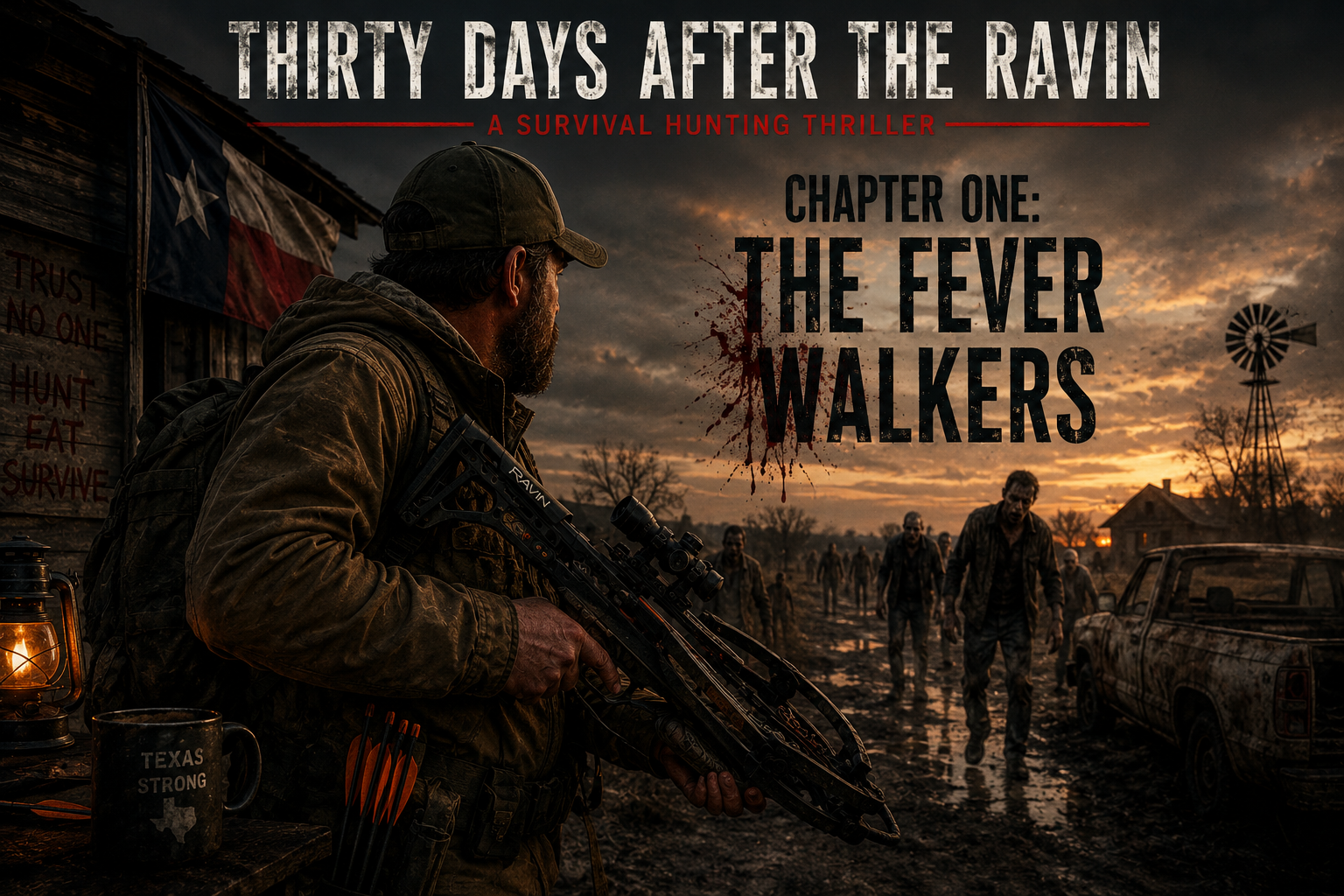
The Ravin arrived thirty days before the world ended.
At the time, I thought it was just another hunting purchase.
A reward for too many overtime shifts, too many years using worn-out gear, and too many mornings dragging myself into the woods before daylight because sitting still in the timber made more sense to me than sitting in crowds ever did.
Now that crossbow hangs beside my bed every night like it belongs there.
Maybe it always did.
I’m not some survival expert from television.
Not a prepper billionaire with an underground bunker.
Not a hero.
I’m a hunter.
Former Army infantry.
Twenty-two years.
Iraq twice.
Afghanistan once.
I know how to move quietly.
I know how to read tracks.
I know how to survive cold, hunger, exhaustion, and fear longer than most men.
But I also know something else.
Training doesn’t stop you from being scared.
It just teaches you how to keep moving while you are.
The first blackout hit on a Thursday night.
The second lasted longer.
By the third one, people in town were fighting over bottled water and gasoline like civilization had already collapsed before anyone bothered telling the rest of us.
Then came the fever.
Then the bites.
Then the videos disappeared from the internet faster than people could upload them.
The government called them infected.
Everybody else started calling them walkers.
Me?
I called them dead.
Because after you put a bolt through something’s skull and watch it keep moving anyway…
you stop caring what official term people use.
You only care whether it’s still coming toward you.
The box came by delivery truck on a gray afternoon that smelled like rain and dust.
Duke heard it first.
He lifted his old yellow head from the porch boards and gave one tired bark, the kind of bark a dog gives when he knows his job but no longer feels like proving anything. His hips were bad, his muzzle had gone white, and he moved slower than he used to, but his ears still caught every strange engine before mine did.
The truck rolled down my gravel drive with too much speed, throwing dust behind it in a pale brown cloud.
The driver looked nervous.
Everybody looked nervous by then.
Not terrified yet.
Not fully.
But nervous in that restless, animal way people get when something bad is moving toward them and they have not decided whether to run or pretend it is nothing.
He handed me the long box without stepping all the way onto the porch.
“You got power out here?” he asked.
“For now.”
He looked toward the county road.
“Lucky.”
Then he climbed back into the truck and left without another word.
I stood there with the box in my hands, watching his taillights disappear around the bend.
The name on the side made me smile despite the weather, despite the news, despite the heavy feeling that had settled over the county.
I had ordered it direct after weeks of studying specs, reviews, hunting forums, and videos of men whispering over dead deer like they had discovered religion.
A compact, serious piece of gear.
Fast.
Quiet.
Accurate.
Built for a man who understood that a clean shot mattered more than a loud story.
I cut the tape on the kitchen table while Duke watched from the doorway.
Inside was the kind of machine you respect before you ever cock it.
Black limbs. Tight lines. Scope mounted like an eye. Everything about it looked purposeful.
I ran my thumb along the stock and felt something I had not felt in weeks.
Confidence.
Not happiness.
Not exactly.
Confidence.
There is a difference.
I bought that Ravin crossbow because I wanted a better hunting tool.
Thirty days later, I would understand I had bought time.
The first blackout came that night.
I was sitting at the kitchen table with the owner’s manual open beside a half-empty coffee cup when the lights flickered once.
Then twice.
Then the whole house went black.
Duke growled from the hallway.
Outside, the wind moved through the cedar trees with a dry whisper that sounded too much like voices.
The power came back after thirty seconds.
The refrigerator kicked on.
The old wall clock resumed ticking.
The television returned to a frozen image of a news anchor standing in front of footage from Dallas. Behind him, people were running across a hospital parking lot while police lights flashed red and blue against the building.
Then the station cut away.
The anchor blinked too much.
He said there were “isolated incidents.”
He said officials urged calm.
He said emergency departments were under “unusual pressure.”
He did not say what everyone online was already saying.
People were biting.
People were dying.
And some of them were getting back up.
I turned the volume down and looked at the Ravin resting across the table.
Thirty days before, it had been a luxury.
That night, it felt like an answer to a question I had not yet heard.
The next week came apart one piece at a time.
Gas went up first.
Then bottled water disappeared. Thank God, (If there is one) I had a decent supply of it.
Then the grocery store put limits on canned goods, batteries, propane, and dog food.
The men at the feed store stopped joking.
The women in line at the pharmacy watched each other’s carts.
People kept their hands close to their pockets.
Every conversation started with weather and ended with rumors.
Somebody’s cousin in Austin saw soldiers blocking a hospital entrance.
Somebody’s brother-in-law in Waco said the morgue overflowed.
Somebody swore a man got shot three times outside a gas station and still crawled under a truck to bite another man’s ankle.
I did what old soldiers and old hunters do.
I checked gear.
Not because gear saves you by itself.
It does not.
A fool with the best equipment is still a fool.
But good gear gives a steady man a few more chances to make the right decision.
I sorted bolts.
Sharpened knives.
Checked water barrels.
Cleaned lanterns.
Found my old rucksack.
Laid out rain gear.
Put fresh batteries in two flashlights.
I made a list of things I should have bought earlier and hated myself for not buying them.
That is the first real lesson of collapse.
You are never as ready as you thought.
I had boots, blades, blankets, rifles, canned food, medical supplies, and enough outdoor experience to outlast most soft-handed men.
Still, I found gaps everywhere.
Too little fuel.
Not enough salt.
Not enough antibiotics.
Not enough feed for the chickens.
Not enough solar.
Not enough time.
That last one was the worst.
Time was running out faster than food.
Three days after the third blackout, I went hunting.
Not because I wanted to.
Because the freezer needed filling while the deer still looked healthy.
Nobody on the radio had said animals could carry the fever, but nobody on the radio had told the truth about much of anything.
The woods behind my place ran down toward Miller Creek through cedar breaks, oak flats, and brush thick enough to tear sleeves if you pushed careless through it. I had hunted those acres since I was old enough to sit still.
That morning, they felt different.
The silence met me at the fence line.
No birds.
No squirrels.
No coyotes finishing their last calls before daylight.
Just cold air and the faint smell of smoke drifting from somewhere toward town.
Duke stayed behind at the house. I hated leaving him, but his hips were bad and I needed quiet.
The Ravin rode light in my hands as I moved through the timber.
That surprised me.
A lot of hunting gear feels good in the store and awkward in the field. This did not. It tucked tight against my body when I eased between cedar limbs. The scope gathered gray morning light cleanly. The weight settled without fighting me.
That mattered.
Everything mattered now.
I found fresh tracks near the creek crossing.
Big buck.
Heavy print.
Moving alone.
For a few minutes, the world narrowed to something I understood.
Mud.
Wind.
Hoof marks.
Broken grass.
The faint warmth of breath inside a cold facemask.
I followed slowly uphill.
That was when I heard the first scream.
Not close.
Not far either.
It came from the direction of the county road and rose sharp enough to stop me mid-step.
A woman, maybe.
Then a gunshot.
Then another.
Then silence.
I stood there with the crossbow half raised, listening.
Nothing moved.
The buck stepped out ten minutes later like the woods had decided to give me one last normal thing.
Eight points.
Thick neck.
Broadside at forty yards.
I raised the Ravin.
The sight settled behind the shoulder.
My finger tightened.
Thwip.
The bolt struck clean and vanished through him.
He ran thirty yards and went down beside a fallen oak.
I knelt by him with one hand on his shoulder.
“Thank you,” I whispered.
My father taught me that.
You thank the animal.
You thank God.
You remember meat is not a product.
It is a life traded for yours.
By noon, I had venison hanging in the shed and blood under my fingernails.
By sundown, the power failed again.
This time, it did not come back.
The first fever walker reached my property two nights later.
I was in the kitchen, sealing venison by lantern light, when Duke started growling at the front door.
Not barking.
Growling.
Low and deep, from the belly.
I froze with both hands on the counter.
Outside, something scraped against the porch.
Slow.
Wood against fingernail.
Then came a wet breathing sound.
I picked up the Ravin from beside the doorway.
The house had gone so quiet I could hear my own pulse.
“Who’s there?” I called.
Nothing answered.
The scraping came again.
Duke barked once, sharp and furious.
Whatever stood outside hit the door hard enough to rattle the frame.
I moved to the side window and pulled the curtain back one inch.
At first I thought it was old man Wheeler.
Same overalls.
Same thin shoulders.
Same white hair hanging in greasy wisps beneath a feed-store cap.
But Wheeler had died two winters ago.
Heart attack while fishing.
I had helped carry the casket.
The thing on my porch lifted its head.
Its face was wrong.
Gray skin.
Black veins.
One cheek torn open so badly I could see teeth through the side.
Its eyes were cloudy, but they fixed on me like it could smell my fear through the glass.
Then it opened its mouth.
The sound it made was not a moan like in movies.
It was worse.
A hungry, broken rasp.
Like lungs trying to remember how air worked.
It slammed into the door again.
Duke lunged forward, barking wild now.
I stepped back, raised the Ravin, and aimed through the window.
My hands did not shake.
Not yet.
That came later.
Training held me steady.
The crosshair found the walker’s face.
I fired.
The bolt punched through the glass and struck just above the left eye.
The thing dropped instantly.
The porch went quiet except for Duke’s breathing and the soft tinkle of broken glass falling from the frame.
I stood there a long time.
Too long.
Then I lowered the crossbow and felt the shaking start in my fingers.
Not because I had killed it.
Because it had already been dead.
I did not sleep that night.
At dawn, I opened the door with the Ravin ready and Duke behind me.
The body lay twisted near the porch steps.
Up close, there was no pretending anymore.
It was not sick.
It was not injured.
It was ruined.
The skin had split at the neck where dark veins crawled beneath the surface like roots. Its hands were torn to bone at the fingertips. There was mud in its mouth and bits of something I chose not to examine stuck between its teeth.
The bolt had done the job.
Head shot.
The radio had been right about that much.
I retrieved the bolt with gloved hands, wiped it clean, and looked toward the road.
More smoke rose beyond the tree line.
Somewhere out there, town was dying.
Maybe already dead.
I dragged the walker into the burn pit and stood there a while before lighting it.
The smell was terrible.
Sweet and rotten.
It clung to my clothes, beard, and memory.
While the fire took hold, I thought about the buck hanging in my shed.
The rabbits still moving in the brush.
The chickens scratching behind the coop.
The deer trails crossing the creek.
The land could still feed me.
For now.
But if the fever reached the animals, everything changed.
Every hunt became urgent.
Every clean piece of meat became treasure.
Every trip into the woods became a gamble.
That morning, as smoke rose from the pit and the world beyond my fence line fell apart, I made my first real decision of the end times.
I would not wait for rescue.
I would not waste daylight.
I would hunt while there was still something clean left to hunt.
I went inside, packed my field bag, checked the Ravin, and pulled on my boots.
Duke watched me from the doorway.
“You coming?” I asked.
He stood slowly, old bones complaining, but his eyes were clear.
Good dog.
The dead had found my porch.
The living would find my meat soon enough.
And somewhere beyond Miller Creek, the woods were waiting.
Thirty days after the Ravin arrived, the world ended.
But my hunt had just begun.